Reasoning in chains
A chain puts several applications in sequence: each step passes its answer to the next, and conditions decide the path. What used to take several launches now takes one.
A chain, block by block
Here is a chain as you would draw it: a trigger, two applications and a condition between them.
-
1Trigger
A request comes in
Your software sends the customer’s message through the API.
-
2Application
Summarize the request
Reads the message and extracts the essentials in three lines.
-
3Condition
Does the answer contain “urgent”?
True: the chain goes on. False: it stops here.
-
4Application
Draft the reply
Writes a reply ready for review, based on the summary.
The three kinds of blocks
- Trigger
The starting point. The chain starts on demand, when you launch it.
- Application
A working step: it runs one of your applications with the answer it received.
- Condition
A switch: a rule tests the previous answer and sends the flow down the true or the false branch.
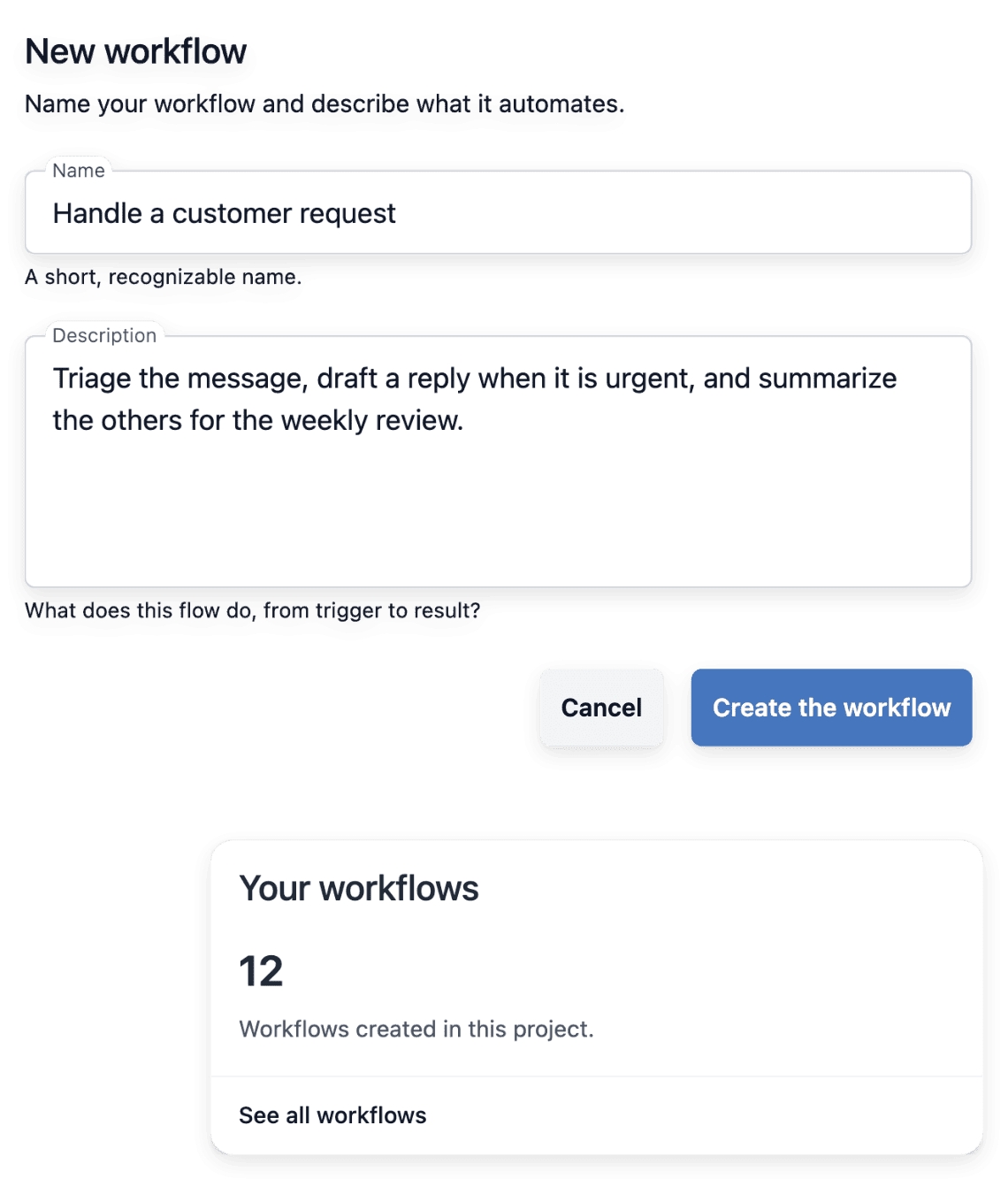
Start a chain from your workspace
Name the chain and say what it does. You then add its steps in the editor, each one an application of your workspace or of the catalogue.
Conditions you can read
- Contains, does not contain
The branch depends on a word or phrase present in, or absent from, the answer.
- Equals
The answer must match the expected value exactly, for example a category.
- Is not empty
The chain goes on only if the previous step did return an answer.
Why chain
- More reliable tasks
A step that does one thing is easier to tune and check than one long instruction that does everything.
- Each step, its own instructions
One step to sort, another to write: each application keeps its own instructions and its own fields.
- Readable usage
Each step is a run in its own right: you see what each one received, answered and used.
Example chains
- Customer service
Summarize the request, detect urgency, then draft the right reply.
- Documents
Read a scanned document, extract its information, then check it.
- Content
Write a text, translate it, then check its tone before publishing.
Which tasks would you chain?
Describe the steps you repeat; we will help you turn them into a chain.
Questions about Ultineo Reasoning
Yes. Each application step is queued as a run and billed on the tokens it uses.
No. You place the blocks on a canvas and connect their outputs in your workspace.
The path taken, step by step, with the answer of each one.